Industrial Automation Trends 2026: Navigating the Next Wave of Smart Manufacturing
The industrial automation landscape of 2026 is defined by the deep convergence of IT and OT, driven by AI, edge computing, and robotics. This article explores the ten key trends reshaping smart manufacturing, from autonomous operations and digital twins to cybersecurity and sustainable practices, offering a strategic roadmap for manufacturers.
Industrial Automation Trends 2026: Navigating the Next Wave of Smart Manufacturing
Introduction: The State of Industrial Automation in 2026
The industrial automation landscape of 2026 is unrecognizable from just a decade ago. We have moved decisively beyond the era of isolated programmable logic controllers (PLCs) and standalone robotic cells. Today, the factory floor is a complex, data-rich ecosystem where operational technology (OT) and information technology (IT) are no longer separate silos but fully integrated layers of a single, intelligent organism.
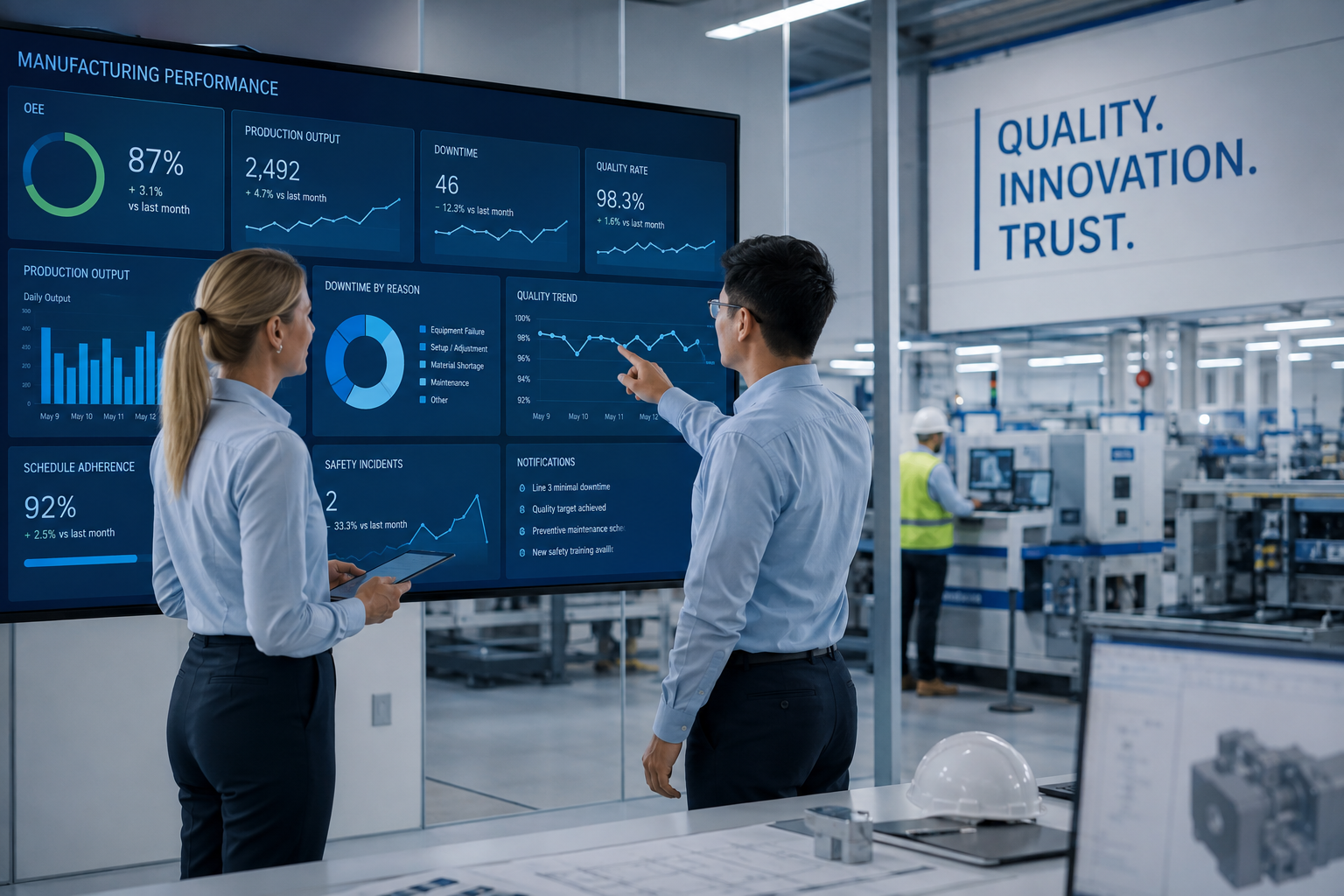
This transformation is driven by a confluence of powerful forces. Persistent labor shortages are compelling manufacturers to automate not just repetitive tasks but also complex, value-added processes. Supply chain volatility demands unprecedented agility and resilience. Simultaneously, stringent sustainability mandates and the relentless pursuit of hyper-efficiency are pushing operational boundaries. The convergence of IT and OT is the foundational trend enabling all of this, allowing for real-time decision-making, predictive operations, and a level of responsiveness that was previously impossible.
As we look at 2026, it is clear we have reached a tipping point for Artificial Intelligence (AI) adoption. Industry projections indicate that more than 60% of new industrial automation projects will now incorporate AI-based components. This is not a future promise; it is the current reality for forward-thinking manufacturers seeking a competitive edge.
Trend 1: AI-Powered Autonomous Operations
The first and most significant trend is the shift from rule-based automation to self-optimizing systems. In 2026, AI algorithms are no longer just monitoring production; they are actively adjusting parameters in real time to optimize for quality, speed, and energy consumption. This marks the era of truly autonomous operations.
Generative AI is revolutionizing the engineering phase itself. We are seeing automated PLC code generation, where engineers describe a process in natural language and the system generates the necessary control logic. This same technology is being used to design digital twins and even create maintenance procedures, drastically reducing engineering time and human error.
This evolution has given rise to Predictive Maintenance 2.0. Modern AI models don't just predict when a failure might occur; they prescribe the corrective action and can autonomously schedule maintenance windows to minimize production disruption. On the factory floor, AI-driven quality inspection systems using computer vision are achieving near-zero defect rates, while autonomous mobile robots (AMRs) learn and optimize their routes continuously, adapting to changing floor conditions.
Trend 2: The Rise of Edge and Cloud-Native Automation
The backbone of real-time control and analytics in 2026 is edge computing. By processing data closer to the source, we reduce latency to near zero, ensuring that critical control loops are not dependent on a distant central cloud data center. This architecture is essential for applications where milliseconds matter, such as precision motion control and safety systems.
Complementing edge computing is the rise of cloud-native automation platforms. These platforms leverage containerized control applications and microservices architecture, allowing for unprecedented scalability and flexibility. Manufacturers can now orchestrate workloads across hybrid environments, running some applications on-premises and others in the cloud. This model also shifts capital expenditure (CapEx) to operational expenditure (OpEx) through subscription-based software, making advanced automation more accessible.
However, this distributed architecture introduces new security challenges. It necessitates a zero-trust security model and robust data governance to protect data integrity and system availability across the entire network.
Trend 3: Digital Twins and Simulation-Driven Engineering
Digital twins have evolved from simple visualization tools into fully interactive simulation environments that mirror entire production lines, including their physical characteristics and real-time behavior. In 2026, they are central to the engineering workflow.
One of the most impactful use cases is virtual commissioning. By simulating the entire production line before physical installation, manufacturers can reduce physical testing time by up to 50%, significantly accelerating time-to-market and reducing the risk of costly errors. These twins are also invaluable for operator training and conducting "what-if" scenario analyses to optimize throughput or test new product variants without disrupting live production.
These are not static models. Through integration with AI and IoT data, they become "living" twins that continuously update based on real-world sensor data, providing a single source of truth for the entire production lifecycle.
Trend 4: Collaborative and Mobile Robotics Expansion
Collaborative robots, or cobots, have moved far beyond simple pick-and-place tasks. In 2026, they are handling complex assembly, precision welding, and intricate material handling, thanks to advanced vision systems and force-sensing capabilities that allow them to adapt to variability.
The most exciting development is the rise of mobile manipulators, or "mobots," which combine the mobility of an AMR with the dexterity of a robotic arm. These systems can move from station to station, performing a variety of tasks, offering a new level of flexible, on-demand automation. New safety standards and sensor technologies are enabling closer human-robot collaboration without the need for safety cages, allowing humans and robots to work side-by-side on shared tasks. Furthermore, lower-priced cobots and Robot-as-a-Service (RaaS) models are democratizing automation, making it accessible to small and medium-sized enterprises (SMEs).
Trend 5: Sustainable and Energy-Efficient Automation
Automation is a key enabler for achieving net-zero targets. In 2026, we see a strong focus on using automation for energy monitoring, optimized machine scheduling, and waste reduction. Smart energy management systems can dynamically adjust production plans based on real-time energy prices and the carbon intensity of the power grid, shifting energy-intensive processes to off-peak hours.
This extends to the circular economy. We are seeing the development of automated disassembly lines and material recovery processes designed for recycling and remanufacturing. Driven by both regulatory pressure and customer demand for sustainable products, the adoption of green automation technologies is no longer a differentiator but a business imperative.
Trend 6: Cybersecurity and Resilience in OT Environments
The threat landscape for industrial control systems (ICS) has never been more severe. Ransomware attacks targeting OT environments are a growing concern, with the potential to halt production and cause significant financial and reputational damage. In response, 2026 is marked by a shift towards "security by design."
Manufacturers are widely adopting the IEC 62443 standards for industrial cybersecurity. Core components of a robust OT security strategy now include network segmentation, anomaly detection, and AI-driven threat response that can identify and neutralize threats in real-time. To further mitigate risk, we are seeing an increased reliance on managed security services and the use of cyber insurance as a key part of overall risk management.
Trend 7: The Human-Centric Workforce and Skills Evolution
Despite fears of job displacement, automation in 2026 is fundamentally transforming jobs, not eliminating them. The factory worker is evolving into a "digital operator" who supervises fleets of robots and AI systems, analyzing data and intervening only when exceptions occur.
This transformation requires a significant investment in upskilling and reskilling programs. Training workers in data analytics, AI, and robotics maintenance is now a top priority for manufacturers. Human-machine interfaces (HMIs) are becoming more intuitive, with AR/VR technologies providing remote assistance and immersive training experiences. To address the skills gap, companies are forging partnerships with educational institutions and establishing internal academies to cultivate the talent they need.
Trend 8: Interoperability and Open Standards
The push for open automation standards is stronger than ever, driven by the desire to break vendor lock-in and enable seamless integration across the value chain. In 2026, standards like OPC UA, MQTT, and IEC 61499 are the foundation for a truly interoperable ecosystem.
This is giving rise to the "plug-and-produce" concept, where modular automation components can be easily reconfigured and reused, much like plug-and-play devices on a computer. Standardized data exchange is facilitated by digital nameplates and Asset Administration Shells (AAS), which provide a common language for assets across their entire lifecycle. Industry collaborations, such as the Open Process Automation Forum (OPAF), are actively shaping the future of system designs, promising more open and interoperable architectures.
Trend 9: 5G and Private Networks for Industrial IoT
5G technology is finally delivering on its promise for the industrial sector. Its ultra-reliable low-latency communication (URLLC) capabilities are enabling wireless control of critical processes and mobile robots, freeing them from the constraints of physical cables.
Private 5G networks are becoming increasingly common on factory floors, offering dedicated bandwidth, enhanced security, and guaranteed coverage. These networks are often integrated with Wi-Fi 6 and Time-Sensitive Networking (TSN) to provide a comprehensive, deterministic communication infrastructure. Real-world deployments in 2026 include 5G-connected Automated Guided Vehicles (AGVs), remote crane operation, and real-time video analytics for worker safety.
Trend 10: Data-Driven Supply Chain Integration
In 2026, automation extends far beyond the factory walls to create a synchronized, data-driven supply chain. Production schedules are now directly linked to AI-powered demand forecasting and dynamic inventory management, creating a more responsive and resilient operation.
Blockchain technology is being used to provide traceability and provenance in automated supply chains, ensuring product authenticity and ethical sourcing. Furthermore, digital twins are being applied to the entire supply chain, allowing companies to simulate disruptions, test mitigation strategies, and optimize logistics in a risk-free environment.
Conclusion: Preparing for the Future of Industrial Automation
The key takeaway for 2026 is that the convergence of AI, edge computing, and robotics is fundamentally reshaping industrial operations. For manufacturers, the path forward requires a strategic approach. We recommend starting with well-defined pilot projects to build internal expertise, investing in robust cybersecurity measures from the outset, and prioritizing workforce development as a core business strategy.
The importance of a phased adoption roadmap cannot be overstated. It allows you to balance innovation with operational stability, ensuring that new technologies are integrated seamlessly. Companies that embrace these trends will not only gain a significant competitive edge in efficiency, sustainability, and agility but will also be better positioned to navigate the uncertainties of the future market. The next wave of smart manufacturing is here, and the time to act is now.